
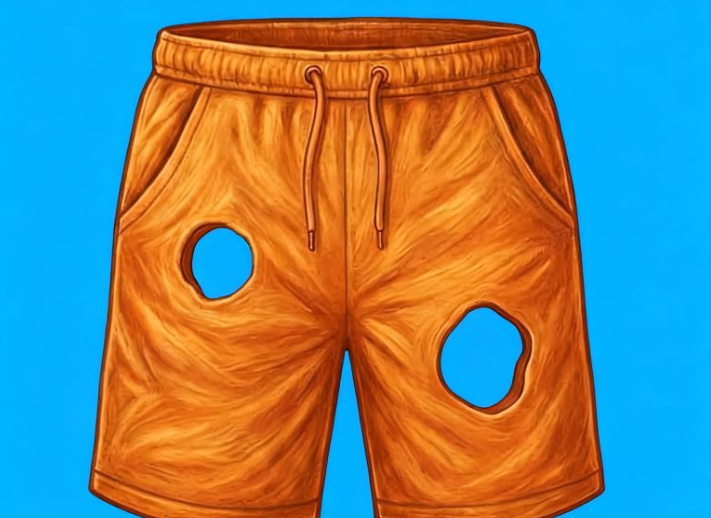
A single photograph showing a torn pair of shorts has recently swept across social media platforms, capturing attention in a way few people expected. At first glance, the image appears ordinary, even mundane. Yet paired with one simple question — How many holes do you see? — it quickly transforms into a visual challenge that pulls viewers in.
What begins as a quick scroll becomes a pause, then a second look, followed by growing curiosity. Many people feel confident in their first answer, only to realize moments later that the image holds more complexity than it initially suggested. This shift from certainty to reconsideration is exactly what makes the puzzle so engaging.
As the image circulates, discussions erupt almost immediately. Comment sections fill with confident declarations, corrections, and thoughtful explanations. Some viewers are convinced the answer is obvious, while others insist the question demands deeper inspection.
The appeal does not come from difficulty alone, but from the realization that perception itself is flexible. Despite exaggerated captions that sometimes claim the puzzle reveals intelligence or personality traits, its true purpose is far simpler. It highlights how the human brain processes visual information differently, depending on focus, assumptions, and perspective.
Most people start by identifying the most noticeable damage: two torn openings in the fabric. This feels logical and satisfying, offering a quick resolution. Yet as soon as someone points out the waistband opening, the answer begins to shift.
Then come the leg openings, which many viewers initially overlook because they feel inherent to the garment rather than part of the puzzle. From there, the debate deepens. Some observers note that the tears pass through both the front and back layers of the shorts, which could double the count. Others argue that structural openings and accidental tears should be counted separately. With each added layer of reasoning, the image transforms from a simple photograph into a surprisingly detailed mental exercise.
What makes this puzzle particularly compelling is how it reveals different thinking styles without labeling them. Some individuals rely on instinct, answering quickly based on what stands out most clearly.
Others take a more methodical route, mentally reconstructing the shorts and examining how fabric layers interact. A third group imagines the item in three dimensions, rotating it in their minds to uncover details that may not be obvious from a single angle. None of these approaches signal superiority. Instead, they demonstrate the many ways people naturally interpret the same information.
Rather than creating division, the puzzle invites conversation. Friends challenge each other playfully. Families debate around dinner tables. Strangers exchange explanations online, often with humor and patience. In these interactions, the image becomes a shared experience rather than a test to pass or fail. The absence of a definitive answer encourages openness, allowing people to listen rather than compete. This sense of low-stakes curiosity plays a large role in why the image spreads so widely.
There is also something comforting about the simplicity of the challenge. In a digital landscape filled with heavy news and complex debates, a harmless visual puzzle offers a moment of light engagement. It encourages people to slow down, observe, and reconsider assumptions — not in a serious or stressful way, but with curiosity. The shorts do not demand expertise or background knowledge. They ask only for attention and willingness to look again.
Ultimately, the torn shorts puzzle is not about arriving at a single number. Its value lies in showing how perception evolves when people take time to reflect. A detail ignored at first can become central moments later. A confident answer can shift without embarrassment. Through this small exercise, viewers are reminded that perspective is shaped by focus, context, and openness. One image sparks many interpretations, and each interpretation adds to the conversation. That shared exploration — more than the final count — is what keeps people looking, talking, and returning for another glance.