
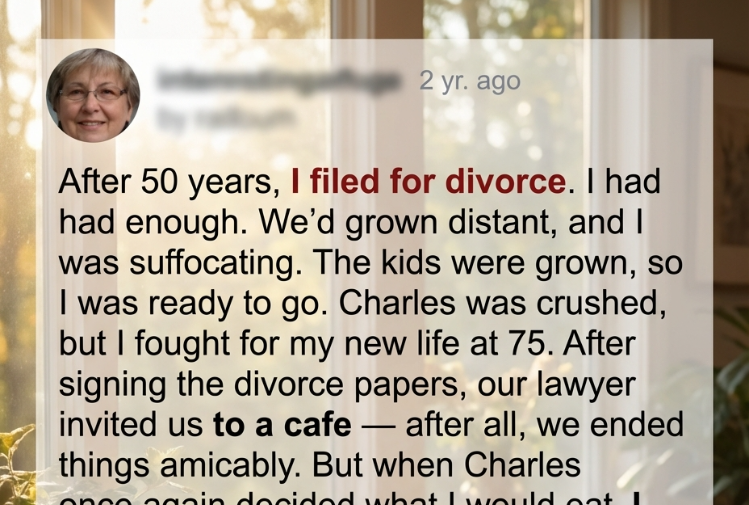
After five decades of marriage, I never expected to find myself questioning whether the life I shared with my husband should continue as it was. At seventy-five, many people cling to what feels familiar, drawing comfort from routines built over years.
I found myself feeling restless instead. My husband, Charles, had not been unfaithful, careless, or cruel. His behavior remained steady and predictable. The change had happened within me. Years spent raising children, maintaining a household, and placing other people’s needs ahead of my own slowly blurred my sense of identity. The home that once felt warm and grounding began to feel narrow, and I misunderstood that feeling as a sign that I needed to leave rather than look inward.
From the outside, our marriage looked admirable. We had shared laughter, loss, celebrations, and quiet evenings that stretched into decades. Friends spoke of our partnership with admiration, pointing to our long history as proof of something rare and lasting.
After retirement, though, the pace of life slowed dramatically. Days repeated themselves, and the silence between us felt heavier. I became irritable over small things, snapping during conversations that once flowed easily.
I struggled to explain the dissatisfaction I felt, even to myself. When I finally told Charles that I wanted a divorce, the words sounded strange in the air. He did not raise his voice or try to persuade me otherwise. He said that if independence was what I believed I needed, he would not stand in the way. His calm acceptance unsettled me more deeply than anger ever could have.
The paperwork was handled quietly, without drama or spectacle. Later that same evening, we went out to dinner together, driven more by habit than intention. As we sat at the table, Charles reached up and adjusted the overhead light, explaining softly that it might be more comfortable for my eyes.
I interpreted that small act as an attempt to manage me rather than care for me. Emotions I had been storing away surfaced quickly and harshly. I spoke with bitterness I did not fully recognize as my own and walked out, convinced I was reclaiming myself at last. That night, I let his calls go unanswered, choosing silence over conversation.
By morning, everything changed. A neighbor arrived at my door with alarming news. Charles had collapsed and been taken to the hospital. The certainty I had clung to the night before dissolved instantly.
I returned home to gather my things and noticed a folded note on the table. It was written in Charles’s familiar handwriting, steady and careful. He spoke of love, patience, and the many small choices he had made over the years to support me in ways he never thought needed explanation. Each line described acts of care so quiet that I had stopped seeing them.
At the hospital, the weight of what I had nearly lost settled fully in my chest. Charles survived, though the doctors explained that recovery would take time and patience. Sitting beside his bed, listening to the rhythmic sounds of the room, I began to understand the truth I had missed for years.
His love had never been restrictive. It had been consistent, gentle, and present in countless moments I had overlooked while searching for something undefined.
In the days that followed, as he regained strength, I reflected deeply on how easily familiarity can disguise devotion. I had mistaken my own restlessness for a failure in our marriage rather than a signal that I needed to reconnect with myself within it. Charles never tried to diminish who I was. He had quietly made space for me all along, trusting me to find my way when I was ready.
Now, I sit beside him each evening, noticing the details I once ignored. The way he prepares my tea exactly as I like it. The way he listens without interrupting. The way his presence steadies the room. I no longer see those actions as obligations or habits. I see them as expressions of a bond built patiently over time.
Whatever years remain, I choose to spend them fully aware of what we share. Freedom did not come from leaving. It came from understanding, from recognizing that love does not always announce itself loudly. Sometimes it waits quietly, hoping to be seen.